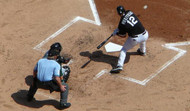
A check-swing definition and challenge system are being tested in Triple A.
We all know what a full swing looks like. When the batter connects, we see singles, doubles and homers. When he misses, it’s a big “swing and a miss,” as announcers call it. We all know what a check swing looks like too. The batter started to swing, then cut it short. He “held up.” He stopped—checked—his swing. He wasn’t trying to hit the ball.
Yet for decades now, home plate umpires (badgered by catchers) have asked the first base or third base umpire if the batter swung on the checked swing. And too many times, the umpire, from 90 feet away, calls a check swing a real swing and a strike.
For thousands of fans, it’s frustrating because it’s constant, irreversible, arbitrary and often wrong. The check-swing strike has no defined criteria.
When is a check swing a strike?
David L., a longtime baseball fan in San Diego, knows what a check swing is: “If the batter checks his swing, but the bat goes beyond being parallel to the front plane of the plate, that’s a swing and a strike,” he says. “That’s what I’ve always heard, and I think that how it’s called.”
He’s absolutely right. And he’s absolutely wrong.
He’s right in that it seems that’s the way most umpires down the line have called it. It’s how a first base umpire determines if a right-handed batter has swung and how a third base umpire rings up a swing on a left-handed hitter—that is, if and only if the home plate ump officially asks for his perspective.
But David is also wrong because there is no actual definition of a check swing and no clear explanation of when a check swing has gone too far and is a strike. In other words, all this time, Major League umpires have just been winging it when calling a check swing a swing-and-a-strike or a non-swing-and-a-ball.
But that might change one day in the Majors, because starting in May 2026, the Triple-A Pacific Coast League has been using a Check-Swing Challenge System to determine whether a batter took a legitimate swing. And it’s totally (and finally) defining a check swing as a swinging strike or not. (We’ll get to that in a minute.)
What is a swing, let alone a check swing?
MLB and the official rulebook have never defined what a check-swing strike is. In fact, the rulebook definition of a swing-and-a-strike is pretty vague as it is. It simply says that a swinging strike is called when the batter “strikes at the pitch,” which puts the decision in the hands of the home plate umpire and whatever he judges to be a real swing.
So, no matter what you or anyone may have thought, there is NO definition of a check-swing strike. A check swing doesn’t become a strike because…
- the batter broke his wrists
- the bat crossed the front plane of the plate
- the bat went past the front foot
- the batter simply “went around”
We all know what a real swing looks like, and a check swing ain’t it. Many fans would agree that the whole check-swing thing is a mess because the system in place isn’t a system at all. It’s always been a judgment call with no clear-cut criteria.
Finally, the check-swing strike is redefined, tracked and certain.
As mentioned, the Triple-A Pacific Coast League has already begun implementing a video- and camera-based Check-Swing Challenge System to finally, officially and technically determine whether a check swing was a swing-and-a-strike or a swing-and-a-ball. (The system has actually been used in the Minors for a few years, but not at the Triple-A level.)
The check-swing system being tested gives the hitter a whole lot of grace and goes way beyond what the check-swing strike threshold has been up to now. Joe Martinez, whose title is “MLB Vice President of On-Field Strategy,” describes the new check-swing criteria this way: “A swing will be considered to have occurred if the maximum angle between the bat head and the bat handle exceeds 45 degrees.”
That’s not much of an explanation. Here’s a breakdown of what he’s saying:
- First, acknowledge that the first base and third base baselines are at a 45-degree angle from the front line of home plate.
- Next, envision an imaginary line or a laser beam running through the bat, from top to bottom in the batter’s hands at the end of his swing, from home plate all the way to first or third base (depending on whether it’s a left-handed or right-handed batter).
- With the new check-swing rule, if a right-handed batter checks his swing, and that bat’s imaginary line is not parallel to first base (vice versa for a left-handed batter), let’s say a 44-degree angle, then the swing IS NOT a strike.
- However, if the bat angle goes to 46 degrees, just beyond parallel to the baseline, then it IS a strike.
Best of all, the Pacific Coast League isn’t relying on an umpire’s judgment. Similar to the ABS strike-challenge system, it’s all tracked by cameras and provides an immediate visual and a swing/no swing determination.
Essentially, batters have just been a lot more leeway to check their swing. That is significantly more of a swing than what most fans view nowadays as the demarcation point of a checked swing. And a Check-Swing Challenge can be made by the pitcher, catcher or the hitter. Each team gets two check-swing challenges per game.
Will check-swing clarity come to the Majors?
MLB Commissioner Rob Manfred hasn’t given any indications that the Check-Swing Challenge System might be coming to the Majors soon. However, it’s closer to the Big Leagues than it has ever been before.
But if and when it does, it will be the end of…
- constant interruptions to the game by catchers asking a line umpire 90 feet away if the batter “went around”
- vague, frustrating, irreversible and unchallengeable “check-swing strike” calls by the first or third base umpire
Finally, the check-swing system will give us a definitive answer to the question: Did he hold up or go around?
It’s what we’ve been dying to know.
Resources: apnews.com/article/robot-umpires-checked-swings; baseballamerica.com/minor-league-rule-checked-swing-challenges; mlbtraderumors.com/2026/03/mlb-to-test-check-swing-rule; wikipedia.org/wiki/Checked-swing; markkolier.medium.com/checking-mlb-checked-swings; youtube.com/watch?v=0Bq1bn4I6mc; youtube.com/shorts/fh4AfShGk1w
si.com/fannation/mlb/mets-top-prospect-in-first-check-swing-review