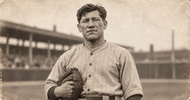
Most baseball fans don’t know that Jim Thorpe played Major League Baseball over a handful of seasons, not long after his Olympic heroics and alongside his standout pro football career. Yes…Jim Thorpe played for a handful of teams from 1913–1919, including the reigning-champion New York Giants in 1913, managed by the famous John McGraw. It’s also believed McGraw mismanaged his star athlete.
And while there are enough quotes that say Thorpe simply couldn’t hit the curveball—even he admitted it gave him trouble—he kept working at it. He didn’t quit, and his batting improved. His last season in the Majors proved that.
He hit .327 in 1919, and then walked away from the game.
After McGraw played him in only two games during two months of the 1919 season, Thorpe demanded a change and was traded to the Boston Braves. Over 60 games the rest of the season, Thorpe batted .327, the highest average on the team. In fact, had he gotten more qualifying at-bats and kept that average, he would have won the National League batting title. (Rogers Hornsby of the St. Louis Cardinals hit .318 that year.)
But from there, Thorpe walked away from Major League Baseball.
Jim Thorpe was a baseball player, and became a good one.
Why don’t most of us today know about his MLB career? A handful of good reasons explain why.
- For one, it was long, long ago. His last season in the Bigs was 1919, more than a century ago.
- Also, although Thorpe’s best season was his last one in the Majors, he didn’t set the baseball world on fire right off the bat as he did in football (college and professional) and track and field, where he was an elite player. He was a solid baseball player, just not one of the best…at the start.
- Thorpe is best known for his Olympics heroics in 1912, when he won both the Pentathlon and Decathlon. And if anything, other fans might know more of his football prowess and success in what is now the NFL, where he was a bona fide superstar long before pro football became what it is today.
- Quite sadly, he is equally famous for being stripped of his medals afterward…for playing baseball before that and getting paid for it. (His medals and records were reinstated decades later.)
“Now batting…Jim Thorpe.”
Giants manager John McGraw wanted Jim Thorpe for his name, not his talents. That’s a fact. Thorpe was perhaps the most famous athlete of the time and got the loudest cheers during a ticker-tape parade in New York City for the U.S. Olympics team. Then, Thorpe was stripped of his Olympic medals in early 1913, which made international news.
McGraw saw an opportunity to cash in on Thorpe’s name and celebrity, and maybe to resurrect Thorpe’s name a bit. He signed him to a contract to play for the Giants, without knowing much about his playing abilities. It was a stunt and a gimmick—more to shine a light on the reigning World Series champs than anything else. When the Giants went on an international goodwill tour at the end of the season, Thorpe was the center of attention.
Put me in, Coach!
Thorpe was frustrated during most of his time in the Majors and had to endure several seasons of little playing time. In his first three seasons with the New York Giants (1913–15), he played in a total of 66 games and appeared in just 17 games in 1915, when he batted .231.
He still wanted to play more and often complained about it, and manager McGraw agreed that Thorpe might improve his game if he played every day. But instead of putting him in the Giants lineup, McGraw sent Thorpe down to the Minor Leagues for more seasoning.
Give Thorpe credit for not quitting, at least. He played for the Minor League Milwaukee Brewers and did well. He batted .275 and stole 48 bases, which earned him a spot on the Giants roster for the 1917 season.
By then, Thorpe was also playing professional football with the Canton Bulldogs and making a name for himself. (He’d been a national college football star as well.) So, who knows what was on McGraw’s mind. His celebrity player wanted more playing time but was also making a name for himself in another sport.
Thorpe breaks up the “dual no-hitter.”
The 20th Century Baseball Chronicle book merely says, “Olympic legend Jim Thorpe…spent six years in the big leagues as the world’s fastest .250 hitter,” and then it spends a few sentences focusing on his low-average seasons. But then they grudgingly write, “He must have gotten a hold of a few pitches” in 1919 when he batted .327.
But he is mentioned as a footnote for a famous game in May of 1917. Thorpe was on loan to the Cincinnati Reds that season. In a game against the Cubs, both starting pitchers pitched no-hitters through nine innings. In the 10th, the Reds got a runner on third with a single and an error, and Thorpe brought him in with an infield dribbler. Reds pitcher Fred Toney wrapped up his no-hitter and the win.
A three-sport professional.
Thorpe’s first MLB season was 1913, and his last was 1919. During that time, he also played pro football for a few years, where he was a star. That means Jim Thorpe was one of the first dual-sport professionals…but you could also add professional basketball (pre-NBA), which he played, making him a three-sport athlete. (We’re not even mentioning his Olympic achievements and gold medals, which were reinstated.)
In 1950, the Associated Press named Thorpe the greatest athlete of the first half of the 20th century, and in 2001 an ABC Sports poll named him the greatest athlete of the entire 20th century. He is a member of the Pro Football, College Football, and National Track and Field Halls of Fame.
Resources: americanfootballdatabase.fandom.com/Canton_Bulldogs; britannica.com/biography/Jim-Thorpe-American-athlete; ghtbl.org/Thorpe; baseball-reference.com/Jim-Thorpe; baseballhall.org/Legend-of-Jim-Thorpe; sabr.com/jim-thorpe; en.wikipedia.org/wiki/Jim_Thorpe